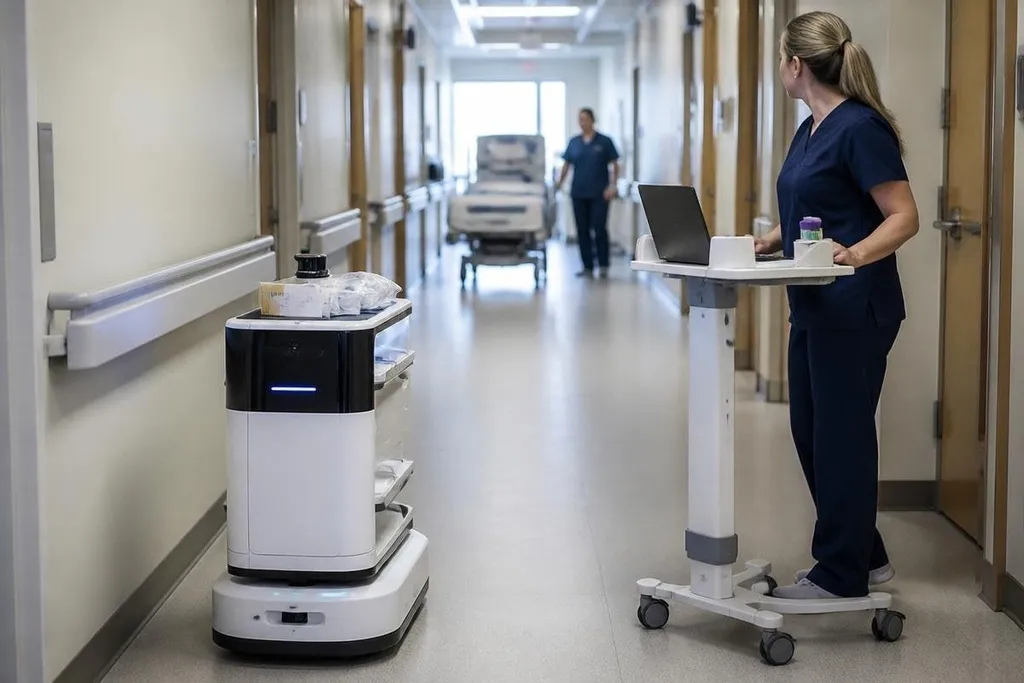
A hospital robot can move supplies, carry samples, or remind staff about a task. None of that proves safer care. The useful question is whether the robot prevents a known error without creating a new one.
- Safety claims need a clear failure, such as a missed dose or delayed alarm.
- A robot must work beside staff, patients, beds, and medical equipment.
- The result needs a measure that a hospital can check before and after use.
Start with the risk
Patient safety covers many different problems, so a robot trial needs a narrow target. A team might study missed supply deliveries, incorrect item transport, delayed alerts, or contact between people and moving equipment.
That target changes the design. For sealed samples, the robot needs different checks from one moving near patients. The first may need identity checks and a secure compartment. The second needs speed limits, obstacle detection, and a clear stop method.
A broad claim such as “the robot improves safety” gives a hospital no useful answer. The team needs to name the event it wants to prevent, how often that event occurs, and what result would count as improvement.
The robot still needs a safe failure mode
Robots work from sensors, software, maps, and instructions. Any one of those parts can give a bad result.
A blocked route can delay a sample. A wrong map can send a mobile robot toward a restricted area. A lost connection can stop a task halfway through.
That does not make the project unsafe by itself. It means the hospital must decide what the robot does when its normal plan fails. It may stop in a safe place, ask a staff member for help, or return to a charging point. The choice depends on the task and the room.
The same check applies to the human side. Staff need to know when a robot is working, when it has stopped, and who can take over. A warning that nobody sees is not a safety measure.
Measure the result, not the demo
A smooth demonstration can show that a robot completed one task. It cannot show how the system behaves across a full shift, during a network fault, or when a person changes the route.
A hospital should compare the robot trial with the earlier process. Useful measures might include missed deliveries, wrong-item events, response time, manual interventions, and stops caused by people or equipment. The exact measures should match the risk under review.
The team also needs a record of near misses. One that avoids injury but stops 20 times an hour may still add work for nurses and porters. That extra work can move risk to another part of the care process.
That risk is easier to judge when a report names the robot, ward, task, and measured result. Robot24.com reports on hospital robots can supply that context, but a safety claim still needs the trial’s limits and the work it adds for staff.
Where robots may help
Robots are most likely to help when the task is repetitive, the route is known, and the result can be checked. A delivery robot can record where an item went. A lifting system can limit motion when a load reaches a set weight. A software system can flag a missing step before a task closes.
These examples describe possible uses, not proof that a specific product improves care. The proof comes from a named trial with a clear measure and a result that staff can check.
I’d reject any hospital robot claim that reports only speed, time saved, or a successful demonstration. Safety needs the number of errors, near misses, stops, and staff interventions tied to the task.
A practical review before purchase
Use this checklist before a hospital moves from a demo to a live trial:
- Name the patient-safety event the robot should affect.
- Record the old process before the robot enters the area.
- Set a safe stop, manual takeover, and recovery procedure.
- Test blocked routes, lost network access, and wrong-item conditions.
- Track near misses and extra staff work during the trial.
- Set a review date and a result that would end the trial.
Patient safety may improve when a robot removes a known source of error and gives staff a safer way to handle the remaining work. Without that before-and-after evidence, the hospital has a machine in a care setting, not a safety result.